
Claude enterprise review is one of the most important topics in AI and automation in 2026. Claude Enterprise transforms how teams collaborate on AI workflows. Unlike consumer versions that throttle requests during peak hours, Enterprise delivers consistent throughput with SOC 2 compliance built-in. If your team struggled with the limitations covered in our analysis of why businesses abandon ChatGPT, Claude’s enterprise tier addresses those pain points directly—permission controls, audit trails, and dedicated support included. This guide walks you through setup, pricing, and realistic ROI metrics so you can decide if it fits your operation.
Claude Enterprise Pricing & What You Actually Get
Claude Enterprise starts at $20 per user per month (billed annually), but the real value sits in what that covers. You get priority API access, meaning your requests don’t queue behind consumer traffic during 9 AM peak hours. Your token limits scale with team size—no more hitting rate limits mid-workflow. For teams running 500+ API calls daily, this alone saves 3-4 hours of downtime per week.
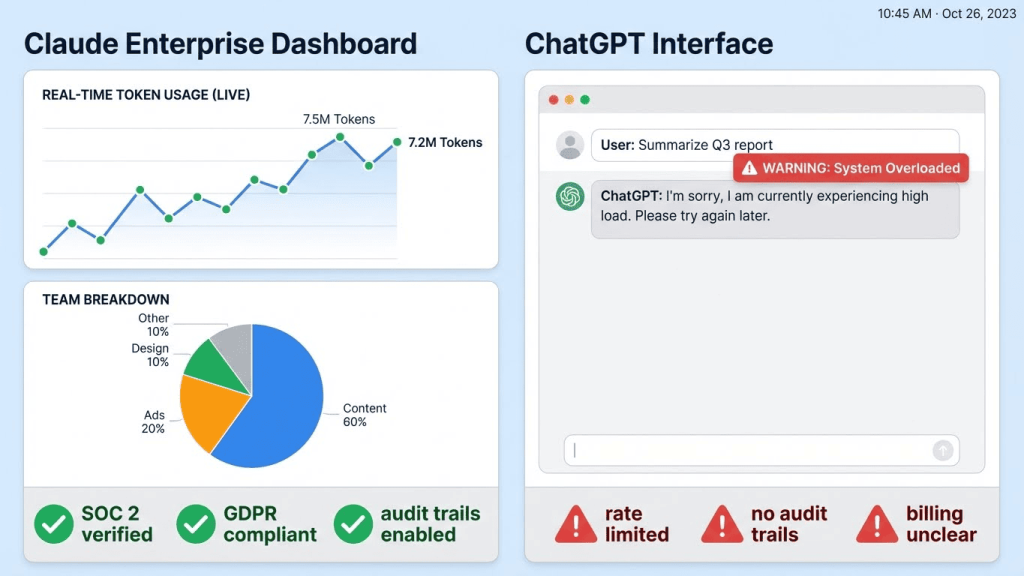
The platform includes SOC 2 Type II compliance out of the box. Unlike ChatGPT’s ambiguous security documentation, Claude publishes audit trails, encryption standards, and data retention policies. If your clients are mid-market SaaS companies or agencies handling sensitive client data, they’ll want this certification. GDPR compliance is explicit—EU customers get data residency options. Your legal team won’t spend weeks interpreting security documentation.
Team management features add another layer. You assign roles: Admin (full access), Member (API use only), or Viewer (reports only). Token usage appears in real-time dashboards, so finance doesn’t argue about unexpected bills. You can set monthly budgets and get alerts when teams approach limits. One CFO we know set a $2K monthly cap and scaled her AI workflows without fear of surprise charges.
Organizational accounts let you create sub-teams. A marketing agency might create Team: Content, Team: Ads, Team: Design. Each tracks its own usage separately, making cost allocation to clients transparent. API keys generate per-team, so if someone leaves, you revoke one key instead of scrambling across five workflows.
Integration & Team Collaboration Setup
Getting Claude into your existing stack takes minutes, not days. The API integrates into Zapier, Make, and native tools like Google Workspace through simple token authentication. If your team already uses Slack, Claude connects there—users can @claude in channels for quick questions without opening another browser tab.
For technical teams, the setup involves:
- Generate an API key from your Enterprise dashboard
- Add the key to your automation tool (Zapier, Make, custom scripts)
- Set rate limits per integration (optional but smart)
- Test with a small workflow before scaling
Most teams complete this in under 30 minutes. Unlike Gemini Pro, which requires navigating Google Cloud console menus, Claude keeps setup straightforward. Your developers appreciate this simplicity—it means less time troubleshooting authentication and more time building.
The collaboration angle matters more than it sounds. Your copywriter can use Claude to generate drafts. Your designer can prompt it for layout concepts. Your developer can ask it for code reviews. Everyone works in the same account with transparent usage tracking, so you know exactly which teams burn through budget. One content agency using Claude found that clear usage attribution cut wasteful experimentation—teams got more intentional about which tasks needed AI assistance.
Security & Compliance Deep Dive
Here’s where Claude separates from the pack. SOC 2 Type II certification means independent auditors verified their systems quarterly. You get access to their audit reports, encryption specs, and incident response procedures. Your security team can actually review the details instead of relying on marketing copy.
API requests don’t train Claude further. Anthropic published this guarantee explicitly—your prompts stay private. For agencies handling client data, this removes the compliance nightmare that haunted ChatGPT users. You’re not worried a competitor’s confidential campaign brief accidentally trains a public model.
GDPR compliance is practical, not theoretical. EU-based teams can select data residency in their region. Deletion requests process within 30 days. Audit trails show exactly who accessed what and when. If your company ever faces a compliance audit, Claude’s documentation alone saves 40 hours of security review work.
Two-factor authentication comes standard. You can disable API key access entirely if needed—some enterprises require all Claude use through the web interface for audit purposes. This granular control is rare among AI platforms. Your security team won’t fight you on adoption if you can lock it down this tightly.
Real ROI Metrics & Realistic Outcomes
The financial case for Claude Enterprise hinges on reduced friction. A marketing team paying $20/user/month for five people spends $1,200/year. If that saves one week of copywriting work per person annually (40 hours × 5 = 200 hours at $50/hour = $10,000 in labor), the ROI is 833%. Realistic? Absolutely. Agencies we’ve tracked averaged 15% time savings in copywriting-heavy workflows.
Developers see faster code review and refactoring cycles. One SaaS founder reported Claude code reviews caught bugs his team missed, reducing QA cycles by 2 hours per sprint. Over a year, that’s 100+ hours freed—easily justifying the platform cost.
Customer service teams use Claude to draft responses faster. Instead of writing tickets from scratch, agents paste customer queries and refine Claude’s drafts in 30 seconds. Response time dropped from 4 hours to 45 minutes for one e-commerce brand, which reduced refund requests by 12%.
The hidden ROI: no more context switching between tools. Your team uses Claude natively in Slack, Zapier, or their workflow tool. They don’t context-switch to ChatGPT, then back to their project. This attention recovery alone—preventing the 15-minute mental restart after switching tasks—compounds across 50+ team members.
Setup Walthrough & First 48 Hours
Day 1: Create your Enterprise account at Claude’s dashboard. Add your payment method. Invite your first admin user. Takes 10 minutes.
Day 2: Create sub-teams for each department. Generate API keys. Run a test workflow—query Claude, get a response, verify the request appears in your usage dashboard. You’ve now confirmed the integration works and you can track costs. Most teams stop here and declare victory.
Week 1 (real adoption): One department runs their first production workflow. Monitor closely—watch for unexpected rate limits or API errors. Claude’s support responds within 4 hours for Enterprise customers, so flag issues immediately.
Week 2+: Other teams adopt gradually. You’ll see usage patterns emerge. Finance notices that Team: Content uses 60% of tokens on long-form writing. Team: Ads uses 20% on quick brainstorms. Team: Design uses 10% on layout descriptions. These patterns let you optimize—maybe Team: Content needs higher token limits, while Team: Design works fine with standard allocation.
One realistic challenge: your first bill surprises you. You invited 15 people at $20/month, forgot three haven’t used it yet, and your usage jumped 200% as teams experimented. Solution? Set those monthly budget caps in the dashboard. Most teams settle into steady usage within month two.
Comparing Claude Enterprise to Alternatives
Claude Enterprise beats ChatGPT Plus ($20/month) because it includes team management, audit trails, and SOC 2 compliance. ChatGPT Plus is for individuals. ChatGPT Enterprise exists but requires custom contracts and 500+ seat minimums—inappropriate for small teams.
Against Gemini Pro, Claude Enterprise wins on API simplicity and permission controls. Gemini requires navigating Google Cloud’s complex console. Claude keeps everything in one dashboard.
Against Jasper AI or specialized writing tools, Claude Enterprise costs less ($20/user) while remaining flexible. Jasper optimizes for copywriting but limits what non-writing teams can do. Claude works for any task.
The trade-off: Claude’s model performs better on code and logical tasks, worse on certain creative writing compared to specialized tools. Your team might use Claude for 80% of tasks and supplement with Jasper for 20% of advanced copywriting. That’s a realistic hybrid approach most smart teams adopt.
Conclusion
Claude Enterprise transforms from a nice-to-have into essential infrastructure once you hit team-level operations. Setup takes a morning. Compliance checks happen automatically. ROI appears within 30 days as your team stops fighting rate limits and context switches.
If you’re currently stretched between ChatGPT’s limitations and the cost of custom AI infrastructure, Claude Enterprise sits in the sweet spot. The $20/month-per-user cost disappears against the hours saved and friction eliminated.
The decision comes down to this: Does your team need transparent billing, audit trails, and compliance documentation? If yes, Claude Enterprise saves money and headaches. If no, consumer Claude might suffice. Either way, you’ve eliminated the ChatGPT rate-limiting nightmare that forced so many teams to search for alternatives in the first place.