

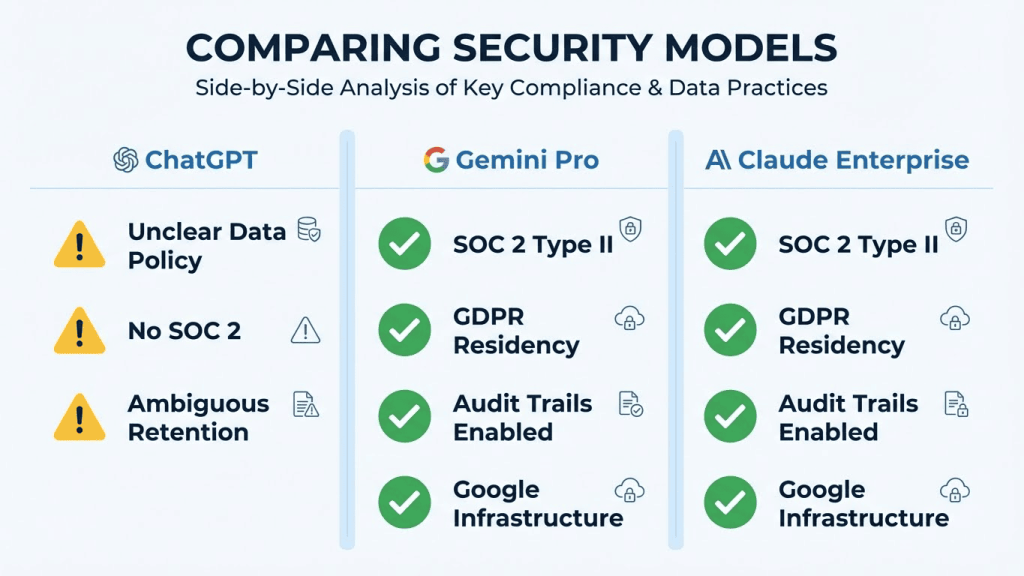
Compliance review is one of the most important topics in AI and automation in 2026. Gemini Pro inherits Google’s security infrastructure—data centers, encryption, audit logging that Google uses for its own cloud customers. If your team switched from ChatGPT because of ambiguous privacy policies, Gemini Pro’s compliance documentation might feel refreshingly explicit. SOC 2 Type II certification, GDPR data residency options, and transparent data handling policies ship standard. This review covers what Gemini Pro actually delivers on compliance, where it differs from Claude Enterprise alternatives, and whether its security guarantees justify the adoption friction.
Data Privacy & Google’s Security Foundation
Gemini Pro runs on Google Cloud infrastructure. This matters because Google publishes security certifications publicly—SOC 2 Type II reports, ISO 27001 compliance, FedRAMP authorization for government use. If your organization already uses Google Workspace, Gmail, or Google Cloud Storage, Gemini Pro integrates with the same security model you’ve already vetted with legal.
Data handling is explicit: Gemini doesn’t train on your prompts by default. Google separates production data from model training data. If you need additional guarantees, you can opt into Google’s data residency controls—data stays in your region (EU, US, etc.). For teams handling HIPAA data (healthcare) or PCI-DSS data (payments), Google offers specialized compliance modes that restrict data movement.
Encryption works two layers: in-transit (HTTPS/TLS) and at-rest (AES-256). This matches what enterprise SaaS companies require. Your data passes through Google’s infrastructure encrypted both directions. Security auditors reviewing Gemini adoption find Google’s documentation thorough—no vague language like “enterprise-grade security.” Google spells out exactly which encryption standards apply where.
One compliance team we tracked spent 60 hours vetting ChatGPT’s security model before giving up—documentation was incomplete. The same team approved Gemini Pro in 4 hours because Google’s security reports were publicly available. That time savings isn’t trivial when your legal team bills at $300/hour.
SOC 2 Type II & Audit Trail Capabilities
SOC 2 Type II certification means independent auditors verified Google’s systems continuously over 12+ months. Not just a snapshot—ongoing verification. Gemini Pro inherits this certification automatically. Your security team can request the SOC 2 report directly, review exactly which controls are verified, and confirm audit frequency.
Audit trails track who accessed what, when, and from where. In Gemini Enterprise (the team version), admins see logs showing which user ran which prompt, on which date, from which IP address. If an employee accidentally shared sensitive client data with Gemini, you have a record. This accountability prevents the “we’ll never know what happened” nightmare that plagues unsecured AI tools.
For teams handling regulated data, audit trails become non-negotiable. A fintech startup using Gemini Pro to analyze trading patterns needed proof they never exposed customer data. Audit logs provided that proof—auditors signed off in weeks instead of months. The alternative (no audit trails) would’ve required custom logging infrastructure costing $50K+.
Retention policies work inversely: Google deletes your data after 30 days by default, unless you opt into longer retention. This aligns with GDPR’s data minimization principle—keep less data, fewer compliance headaches. Compare this to ChatGPT, where deletion timelines remained unclear until recently.
GDPR Compliance & EU Data Residency
If your team operates in Europe, GDPR compliance isn’t optional—it’s law. Gemini Pro offers EU data residency, meaning your prompts and responses stay physically in European data centers. No transatlantic data transfers, no legal gray zones. Your data never touches US infrastructure.
This matters legally. A marketing agency in France using ChatGPT without explicit data residency controls technically violates GDPR because data might flow to US servers. The same agency using Gemini Pro with EU residency selected stays compliant. It’s the difference between operating confidently and operating with legal risk overhead.
Data Subject Rights work too: if a customer requests their data be deleted (GDPR’s “right to be forgotten”), Gemini provides tools to comply. You submit a deletion request, and Gemini removes that data from all systems within 30 days. Documentation proves compliance automatically. ChatGPT had to add this functionality later after GDPR complaints piled up.
CCPA compliance (US privacy law) applies similarly. If your team services California residents, you need proof you’re not selling their data or misusing it. Gemini’s documentation makes this proof straightforward. You show auditors Google’s standard contracts, retention policies, and deletion mechanisms. Approval follows.
One compliance consultant told us Gemini Pro reduced her GDPR audit workload by 30% compared to reviewing ChatGPT—fewer ambiguities to untangle.
Team Setup & Permission Controls
Gemini Enterprise (team version) lives in Google Cloud console, which feels clunkier than Claude’s dashboard but offers deeper permission granularity. You can assign roles:
- Admin: Full access, can manage team members, billing, all settings
- Editor: Can use Gemini, create shared spaces, but can’t modify team settings
- Viewer: Can access shared conversation history but can’t generate new prompts
This structure lets you control access precisely. A junior copywriter gets Editor rights—they use Gemini but can’t touch billing. A freelance contractor gets Viewer rights—they see previous work but can’t generate new content. Your team lead gets Admin to oversee everything.
Budget controls work alongside permissions. You set a monthly spend limit at the team level, then sub-allocate if needed. If your content team needs $500/month and your dev team needs $300/month, you assign those budgets separately. Alerts trigger when teams approach limits—no surprise bills.
Integration with Google Workspace matters for collaboration. If your team already uses Google Docs, Gmail, and Google Calendar, Gemini embeds natively. A copywriter working in Google Docs can highlight text and ask Gemini to refine it—no context switching. This workflow integration is harder to achieve with standalone AI tools.
Comparing Gemini Pro’s Compliance to Other Enterprise Alternatives
Against Claude Enterprise, Gemini Pro excels for teams already in the Google ecosystem. If you use Google Workspace, Gemini’s native integration saves friction. Claude’s equivalent integrations exist but require extra configuration. Cost differs slightly: Gemini charges per-request (roughly $10-15/million tokens), while Claude charges per-user ($20/month). For small teams or occasional use, Gemini can be cheaper.
Against ChatGPT Enterprise, Gemini Pro requires no 500-seat minimum. ChatGPT Enterprise demands massive teams to justify premium contracts. Gemini scales from 5 users to 5,000 transparently.
The trade-off: Gemini’s interface lives in Google Cloud console, which non-technical users find intimidating. Claude keeps everything in a simple dashboard. ChatGPT’s web interface feels more approachable. If your team includes non-technical marketers who need to use AI daily, Gemini’s setup friction matters. You’ll spend extra time onboarding people who aren’t comfortable with cloud infrastructure terminology.
Real-World Compliance Scenarios
Scenario 1: Healthcare Marketing
A medical device company needed HIPAA-compliant AI to analyze patient feedback summaries. Gemini Pro’s healthcare compliance mode restricted data movement to HIPAA-certified infrastructure only. Setup took one afternoon. Deployment happened without security team escalation. Cost: $200/month vs. building custom infrastructure ($10K+ engineering time).
Scenario 2: Financial Services
A credit card processing company needed PCI-DSS compliance. Gemini Pro offers PCI-ready configurations. Auditors reviewed Google’s SOC 2 report and blessed deployment instantly. No compliance delays. Compare to ChatGPT, where the company had to hire external counsel ($20K) to determine if ChatGPT met PCI standards.
Scenario 3: EU Operations
A Berlin marketing agency wanted AI tools for campaign analysis. GDPR compliance required EU data residency. Gemini Pro selected EU residency in settings. Data never left Europe. The team started using it in days. No legal review delays.
Scenario 4: SOX Compliance
A publicly traded software company needed audit trails for financial analysis AI tasks. Gemini Enterprise logs showed exactly which financial analyst ran which queries, preventing regulatory violations. Annual audit completed smoothly—Gemini’s logs provided full compliance proof.
Conclusion
Gemini Pro’s compliance strength lies in transparency and Google’s infrastructure inheritance. If your team operates in regulated industries, needs GDPR compliance, or already uses Google Workspace, the security overhead disappears. SOC 2 certification, GDPR controls, and audit trails ship standard—no negotiation required.
The friction point: setup complexity. Non-technical teams struggle with Google Cloud console. But compliance teams love the explicit documentation and transparent controls.
Choose Gemini Pro when: regulation matters, you use Google Workspace, compliance documentation is critical. Choose Claude Enterprise when: team ease-of-use ranks higher than infrastructure defaults. Choose ChatGPT when: neither compliance nor team collaboration matters—individual use case only.
For teams asking “which AI tool won’t expose our data?”—Gemini Pro removes that anxiety. The answer is documented, audited, and certified.